A Developing Story, Read Before You Share
A developing story checklist helps you decide what to share now, what to hold back and how to correct your wording as coverage changes.
The common mistake with a developing story is to treat the first alert as a finished account. That can turn an early description into a settled narrative before the central question has even been asked. A developing story checklist helps you decide what to share now, what to hold back and how to revise the account as coverage changes.
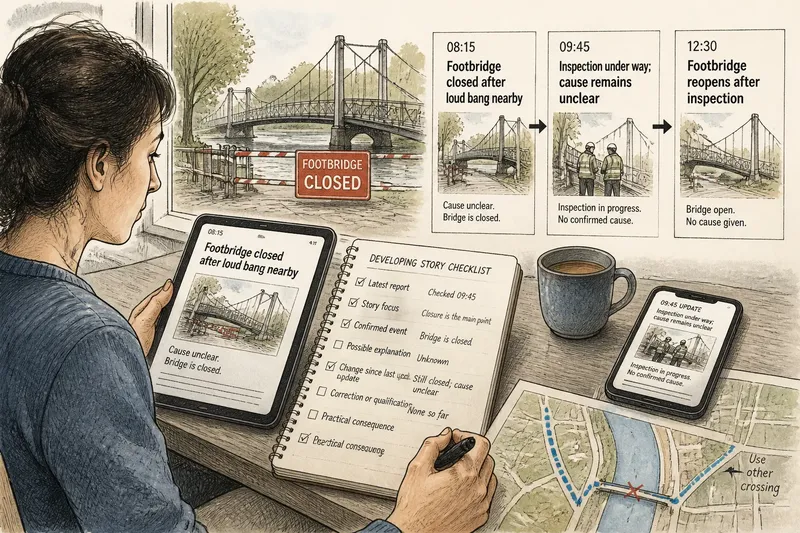
Say a local outlet reports that a riverside footbridge is closed after a loud bang nearby. The closure is the immediate news; the cause is not yet clear. The editorial question is how the story may change: might the closure be lifted, might a new explanation emerge, or might the outlet correct its first account? The scenario is invented, but it shows why a developing story is not just a collection of claims. It is a sequence of accounts.
Why can the story’s shape change?
Early coverage often starts with a narrow event and widens as reporters learn more. A headline may foreground the closure, while a later update may focus on an inspection or explain why the bridge was shut. This is a change in the story’s emphasis, even if the original statement about the closure remains accurate.
Separate three things: the event being reported, the explanation being considered and the questions still open. In the bridge scenario, the closure is the event; the bang may be relevant context; its cause is an open question. Keeping these categories apart makes it harder for a possible explanation to take over the story before it is established.
Also notice what a report chooses to foreground. A dramatic detail can dominate a headline even when the article gives it little weight. That does not by itself make the coverage misleading, but it is a reason to read beyond the headline and ask whether the emphasis matches the information provided.
How can you track a story without chasing every alert?
Choose one or two outlets that are already covering the event, then revisit their reporting when a meaningful update appears. Look for a changed headline, a new explanation, a correction or a clear statement that an earlier detail remains unresolved. A fresh timestamp alone may indicate a new post, not a new answer.
Make a small running note if the story matters to a decision you need to make. Record the outlet’s wording and the time you saw it, then add what has changed in the next update. This is useful for practical stories such as transport disruption, where the relevant question may be whether a route remains closed, not every detail of how the disruption began.
There is little value in refreshing a page every few minutes or reading every comment beneath it. Those actions can create the feeling of progress without adding a clearer account. Check again when the outlet signals a substantive update or when the information affects what you need to do.
What should a developing story checklist include?
Use these checks to judge the story’s stage and the next sensible action. Each item asks what you can observe and what to do if the answer is unclear.
- Latest report: Check the publication time and whether the outlet has posted a newer account. If a newer report exists, read it before sharing; if not, describe the information as the outlet’s current account.
- Story focus: Check what the headline emphasises against the main details in the body. If the headline gives a stronger impression than the text supports, share the narrower detail or omit the headline’s implication.
- Confirmed event: Check which part of the event the report states plainly, such as a closure. If that point is clear, you may describe it with the outlet’s attribution; if it is only suggested, wait or say the report is still assessing it.
- Possible explanation: Check whether a cause is stated as established, considered or unknown. If it is only a possibility, label it as such or leave it out; if no explanation is given, do not supply one yourself.
- Change since the last update: Compare the new account with the earlier one. If the outlet adds or corrects a detail, make that change explicit when you pass the story on; if nothing material changed, do not imply that the situation has been resolved.
- Correction or qualification: Check for wording that revises an earlier statement. If the outlet corrects itself, use the corrected account and mention the correction where relevant; if the qualification is unclear, avoid repeating the disputed detail as settled.
- Practical consequence: Check whether the report tells you something that changes what you need to do, such as using another route. If it does, act on that limited information; if it does not, wait for a useful update rather than sharing speculation.
Picture a reader who sees the invented bridge report at breakfast and needs to walk across the river later. First, they note that the outlet says the footbridge is closed and gives no confirmed cause. Next, they check the outlet’s latest update before leaving; it still reports the closure, but says the cause remains unclear. They decide to use the other crossing and tell a neighbour only that the outlet reports the bridge closed. The observable result is a changed route and a message that does not turn the unexplained bang into a claim about damage.
How do you recognise a shift in the account?
Compare what the outlet says now with what it said earlier. A story may shift because a detail has been confirmed, because an earlier description was corrected, or because the report has moved from immediate events to their consequences. Those are different kinds of change and should not be collapsed into “the story changed”.
For instance, an update that says an inspection has taken place adds a new development. It does not answer the cause of the bang unless the outlet says so. If a later report states that the bridge is open again, that changes the practical advice but does not necessarily explain why it was closed.
When sharing an update, name the new element rather than saying only that there is “more information”. That gives readers a clear sense of what has moved and what remains open.
Which questions help you follow the story?
Does a new timestamp mean the report has changed?
Not necessarily; an outlet may refresh a page without resolving the central question. Compare the text or headline with the earlier version, and describe only a change you can identify.
Should I wait until the account is complete?
No, if a limited detail is useful and clearly presented as the outlet’s current account. If the detail is not useful yet, waiting can be more sensible than circulating an incomplete explanation.
What if the headline and article give different impressions?
Use the narrower wording supported by the article’s details. If the mismatch affects the main point, avoid repeating the headline and check whether the outlet later clarifies it.
When is a correction more than a routine update?
A correction signals that an earlier detail was wrong or materially misleading, while a routine update may add new information without replacing the earlier account. Follow the outlet’s correction wording and do not keep circulating the superseded detail as current.
How should you handle an update after sharing?
If new coverage changes something you passed on, return to the place where you shared it and add a visible correction or update. State what the earlier report said, what the newer account says and which practical point has changed. This is especially useful when someone may act on the earlier message.
In the invented bridge scenario, suppose the outlet later reports that the bridge has reopened but still gives no confirmed cause for the bang. A useful update would say that the outlet now reports the bridge open, while the cause remains unclear. That corrects the route information without pretending the explanation has been settled.
A developing story checklist is most useful when it helps you notice movement in the account: what is newly reported, what has been revised and what still has no answer. Follow those changes at a pace that serves your decisions, and leave the rest of the story’s shape open until the reporting gives you a reason to close it.