Who Saw It, Who Recorded It, Who Repeated It?
Trace a news claim’s source chain to separate direct observation from later retellings, and see which parts of a report rest on an identifiable source.
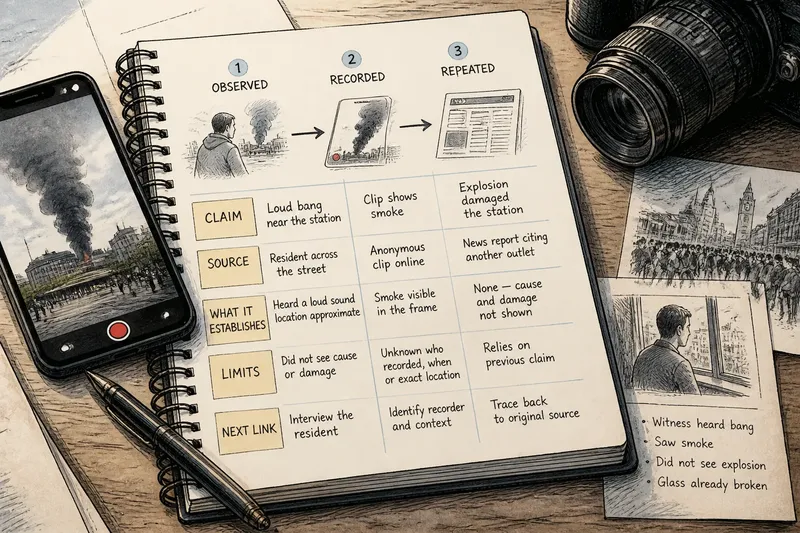
The common mistake when tracing a news claim’s source chain is to count every outlet or quoted person as fresh confirmation. That can make one account look like several independent reports, obscuring what is actually known. Follow the origin of each detail instead: who observed it, who recorded it and who passed it on.
What is the exact claim?
Write down the specific statement you want to assess. “A loud bang was heard near the station” is different from “An explosion damaged the station”. The first concerns a sound and its reported location; the second adds both a cause and an outcome.
Separate an observable detail from the interpretation attached to it. A video may show smoke, while the claim that it came from a fire at a nearby factory requires another link. This distinction helps identify which source can speak to which part of a report.
Note where you encountered the statement and how it was attributed. Phrases such as “according to a resident” or “officials said” identify a route to investigate; they do not, by themselves, establish what the source knows.
Who could observe the detail directly?
A first-hand source is someone who says they perceived the particular event themselves. A person may have seen a vehicle turn, heard an announcement or watched a building empty. Their direct account applies to that detail, not automatically to the cause or wider significance.
Consider the source’s position and the limits of perception. Someone across a crowded street may report a flash without being able to identify its cause. A person inside a building may hear an alarm but not know what triggered it.
Also distinguish witnessing an event from seeing its aftermath. A resident who sees broken glass can describe the glass. Unless they saw it break, they cannot establish when or how it happened.
What does a recording establish?
Video, audio and photographs preserve parts of a scene, not a complete account. A clip may show movement or a particular sound, but it may not reveal what happened before or after, who made the recording or whether its caption is accurate.
Check whether the report identifies the recorder and explains how the material’s location or timing was assessed. If it calls the item only “a clip circulating online”, the chain has not yet reached a named person who made it.
Keep what the recording shows separate from claims about motive or context. A clip might show a door closing; a post might claim it was locked to keep people out. The visible action and the stated reason require different support.
How does a claim pass from source to report?
Map the hand-offs in order. A claim might pass from an observer to a local post, then to a news desk and on to another outlet. Record the source named at each stage. When one report cites another, mark the link rather than treating the later article as a new origin.
Retellings can change the apparent strength of attribution. “A resident said they heard a bang” may become “witnesses reported an explosion”, then “reports say an explosion occurred”. The wording sounds broader, but it may still lead back to one person’s account.
Notice whether a newsroom spoke directly to its source or is summarising another publication. An interview is a direct exchange, though the interviewee’s knowledge still has limits. A report that cites another outlet points back along the chain.
How can you tell whether two accounts are independent?
Different publishers do not necessarily mean different origins. Several outlets may repeat the same agency statement, interview or social-media post. For the detail being checked, ask whether each account reached it through a separate route.
Compare the sources named, the material cited and the wording used. Similar language can be a clue that accounts share an origin, although it is not proof of copying. A separate interview or contemporaneous record may add another route, but only for the details it can establish.
For instance, a public notice might confirm that a road is closed without explaining why. Treat that as support for the closure, not as confirmation of an alleged crash.
What should you search for in a source chain?
What does “according to witnesses” tell me?
It tells you that the report attributes a claim to people described as witnesses, but not how many there are or whether the journalist spoke to them directly. Look for named accounts, the detail each person says they observed and how the newsroom obtained them.
Does an unnamed source mean the claim is false?
No. An outlet may explain why a source is unnamed, but anonymity makes it harder to assess that person’s access and role. Check what basis for knowing the report provides and whether another route supports the same detail.
Can a video establish who was responsible?
A video may show a person or action, but responsibility can depend on identity and context beyond the frame. Separate what is visible or audible from what a caption or another source asserts.
What if several reports cite the same post?
Record the post as their shared origin unless a report identifies a separate route. The spread of the claim may be relevant to how it circulated, but it does not create another observation of the event.
How can you record the chain without overclaiming?
- Check the report’s precise wording; if it combines an observation with a cause, record those as separate claims, and check each separately.
- Check who is named as the earliest source; if the person is identifiable, note their reported basis for knowing, and if not, mark the origin as unidentified.
- Check whether the source saw the event or only its aftermath; if they saw it, state which detail they observed, and if they saw only the aftermath, do not attribute the event’s cause to them.
- Check whether a recording’s maker and context are given; if they are, note what the material visibly or audibly captures, and if they are not, describe those details as unverified.
- Check whether a report cites another outlet or post; if it does, follow that link back, and if it does not identify its route, leave the source chain unresolved.
- Check whether a separate account or record supports the same specific detail; if it does, note what that route can establish, and if it leads back to the same origin, count it as a retelling instead.
Say what the chain supports and identify the remaining gap. “The clip shows smoke; the poster says it came from the warehouse” separates the visible material from the poster’s account. If the recorder is unknown, say so rather than filling in the missing link.
Imagine a reader finds three local reports about a closed road. Each cites the same message from a resident, who says they heard a crash but did not see it. The reader notes that the reports describe a closure, while the crash account traces to one message and its cause remains unsupported. The distinction is not whether the story has circulated widely, but which source supports each detail.
For a useful note, keep the claim, its earliest identifiable source, the route into the report and the unresolved detail together. It is not worth following every repost once the links plainly return to the same post; record that shared origin and move on. A clear source chain helps readers assess attribution without mistaking a story’s circulation for evidence about the event.