Two Headlines, One Report: What the Verb Changes
Compare two headlines about one report by tracing each verb to its source, so you can spot shifts in certainty, attribution and meaning before sharing.
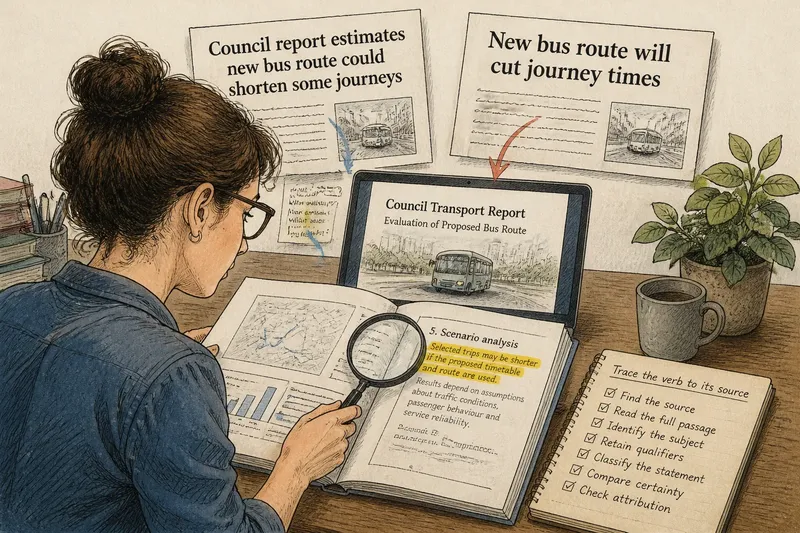
The common mistake with two headlines about one report is to compare their verbs without checking what each one describes. In a pair about an invented council report, “estimates” and “will deliver” can turn a qualified projection into a promise. Trace the verb to its subject and source before deciding what either headline claims.
How can you compare headline verbs?
Headlines compress a larger account, so a verb may refer to a report’s finding, a person’s statement or a prediction about what happens next. Those are not interchangeable. A difference matters when it changes who is making the claim, how certain it sounds or what kind of claim it is.
Begin with the verb’s subject. “The report estimates” attributes a calculation to a document. “The council says” attributes a statement to officials. “The plan will” presents an outcome as a prediction. Read the whole headline, then identify the source and the claim before judging its strength.
Say you see two headlines about an invented council report on a proposed bus route. One says the report “estimates” that the route could shorten some journeys; the other says the route “will cut journey times”. The report’s stated starting point is a scenario: selected trips may be shorter if the proposed timetable and route are used. Reading that passage supports a qualified estimate, not a firm promise. The practical result is to treat the second headline as stronger than the report’s wording allows.
What do common headline verbs imply?
Some verbs describe the kind of statement being made; others imply how firmly a conclusion has been established. Their meaning depends on the evidence and the surrounding sentence, so no verb should be judged in isolation.
- Finds: reports a conclusion within the document’s scope. Check what was examined; if the headline implies more, read the stated limits before accepting that broader claim.
- Suggests: presents a possible interpretation. If the source gives only qualified support, retain the cautious wording; if it states a firmer conclusion, inspect that passage before deciding whether the headline understates it.
- Estimates: marks a calculated result as an estimate. If assumptions accompany it, keep them attached; if the headline presents the estimate as certain, describe it as a projection instead.
- Projects: describes a future scenario based on assumptions. If those assumptions are explicit, report the outcome as conditional; if they are missing from the headline, check the source before treating the outcome as settled.
- Links: can describe an association. If the source does not establish causation, avoid replacing “linked to” with “caused by”; if it does make a causal claim, verify the passage and its scope.
- Confirms: implies that a claim has been established. If the report says only “may” or “could”, use the qualified wording; if it directly confirms a specific point, keep the claim within that stated scope.
- Warns: attributes a caution to its source, not necessarily a prediction that the outcome will occur. If the source describes a risk, call it a warning; if it states that an event has happened, check whether another verb fits better.
How do you trace a verb to its source?
Open the linked report or the passage cited in the article. Search within a digital document for a distinctive term, then read the entire sentence and the surrounding paragraph. A matching word may appear in a recommendation, a scenario or a quoted opinion rather than in the report’s findings.
- Check the named source. If the headline names a report, find that document; if it names a person or organisation, look for the attributed statement instead.
- Find the supporting passage. If you locate a sentence that makes the headline’s claim, read its context; if you cannot find one, treat the wording as unverified and look for a clearer citation.
- Keep the subject attached. If the report itself makes the claim, attribute it to the report; if a spokesperson makes it, preserve that attribution rather than turning it into a document finding.
- Retain qualifiers. If the passage says “may”, “could” or “in some cases”, carry that limit into your account; if it contains no such qualification, check other nearby limits before strengthening the claim.
- Classify the statement. If it records an observed result, describe it as a finding; if it is a forecast, interpretation or recommendation, name that type instead.
- Compare the certainty. If the headline sounds firmer than the passage, use the source’s narrower wording; if it sounds more cautious, check whether the headline is describing a different part of the report.
If the article does not link the report, see whether it names the document clearly enough to locate. A headline may quote a source’s claim rather than state a report’s conclusion. “The minister says” and “the report confirms” assign responsibility to different speakers.
Why can certainty and attribution shift?
“Proves”, “confirms” and “settles” suggest that doubt has been removed. They may fit a direct, bounded claim, but they can overstate evidence that is partial or qualified. A report can make a useful finding without resolving every question around it.
“Suggests”, “estimates” and “projects” signal different limits. “Suggests” points to a possible interpretation; “estimates” marks a calculation; “projects” describes a future scenario based on assumptions. “Warns” tells you that a source has raised a concern, not that the predicted event is certain.
Attribution matters just as much as certainty. If an official offers an interpretation, a headline should not quietly turn it into an independent finding by a report. Check the sentence’s subject, the verb and any phrase such as “according to” before repeating the claim.
Which headline verb questions should you ask?
Does “finds” mean the same as “proves”?
No. “Finds” can describe a conclusion within a report’s scope, while “proves” implies a stronger resolution of doubt. Check what the document examined and whether its authors make that stronger claim.
Does “linked to” mean “caused by”?
No. “Linked to” may describe an association without establishing cause. Look for a clear causal claim in the source before using a causal verb yourself.
What if the report uses cautious wording?
Keep its limits visible. Words such as “may”, “could” and “is consistent with” restrict the claim, so a headline that drops them may change what readers understand.
What if you cannot access the report?
Use the article’s attributed wording and distinguish it from a direct finding. If you cannot check the source passage, treat the headline’s strongest claim as unverified rather than filling the gap with an assumption.
When is a difference worth challenging?
Pay attention when a verb changes the speaker, turns possibility into certainty or changes an association into a cause. Those shifts can alter the report’s meaning even when both headlines refer to the same document.
Chasing a perfect synonym is not worth the effort when two verbs preserve the same scope and degree of caution. Focus on wording that changes the claim, not harmless stylistic variation.
Before sharing, anchor your wording to the source passage. If an invented report says a change “could help” under stated conditions, do not repeat a headline saying it “will solve” the problem. That is the useful check behind comparing two headlines about one report: keep the verb, its speaker and its limits together.