The First Alert Is a Snapshot, Not a Timeline
Learn how to read an early news alert without mistaking a partial sequence for a settled timeline, and track what later reporting actually clarifies.
The common mistake with an early news alert is to read its order of sentences as the order of events. That can turn a provisional account into a confident timeline before reporters have established what happened first, what followed and what remains uncertain. A first alert is a snapshot: useful for orienting yourself, but not yet a full sequence.
Why does an early news alert leave out parts of the sequence?
Early reports are often assembled while information is still arriving. A newsroom may have confirmation that an incident occurred and a brief account from an official, but not yet know what led up to it or how events unfolded minute by minute. The first alert may therefore describe the most firmly established point, not the beginning of the story.
There is also a practical distinction between confirming an event and reconstructing it. A reporter might be able to confirm that a building was evacuated, for instance, while the cause of the evacuation and the timing of the decision are still unclear. Those are separate claims, and each needs its own support.
Readers can mistake a concise update for a complete account because it has a headline, a timestamp and a definite verb. Those features make information easy to scan; they do not show how much of the sequence is known. Treat the alert as a record of what the newsroom could responsibly say at that moment.
Does the order of details tell me what happened first?
Not necessarily. The order in an alert may reflect what is confirmed, what matters most to readers or what fits the space, rather than a chronological sequence. A report might mention a response before the event that prompted it because the response is the clearest confirmed detail.
Watch for words that explicitly establish order, such as “before”, “after” and “then”. Even these only establish a sequence if the report supports them with a source or a clear account. By contrast, two sentences placed next to each other may describe related events without stating which came first.
Separate three kinds of information as you read: an event that is confirmed, an order that is explicitly reported, and a connection that you are inferring. This small distinction can prevent an alert from seeming more complete than it is.
How can I separate confirmed order from later reconstruction?
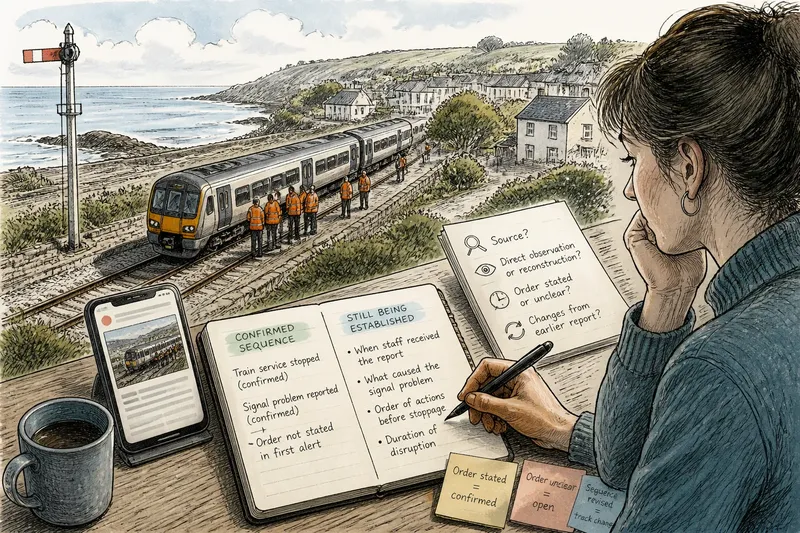
Make a simple two-column note: “confirmed sequence” and “still being established”. Put only explicit, attributed order in the first column. Leave a detail in the second if the report gives no timing, relies on a broad phrase such as “during the incident”, or says that accounts are still being gathered.
Then compare later updates with the first alert. Look for what has changed in the sequence, not just what new detail has appeared. A later account may clarify that one action preceded another, correct an earlier ordering, or explain that separate events were initially treated as one continuous episode.
Say you read an alert saying that a train service stopped after a signal problem was reported, but it does not say when staff received the report. You would record the stoppage and the reported problem as confirmed details, while leaving their precise order unresolved. If a later update states that staff received the signal report before stopping the service, that order can move into the confirmed column, with the update’s attribution kept alongside it.
This is not a demand to maintain elaborate notes. A few words beside the report—“order stated”, “order unclear” or “sequence revised”—are enough to stop a plausible guess becoming a remembered fact.
What should I look for in a follow-up report?
Check whether the later report names the basis for its account. It may cite a witness’s description, a public statement, a document or footage. These sources can illuminate different parts of a timeline, and a report is stronger when it makes clear which source supports which point.
Notice whether the update distinguishes direct observation from reconstruction. A witness may describe what they saw, while investigators or reporters piece together events the witness did not observe. A clear account will not quietly turn an inferred link into something everyone directly saw.
Also check whether the update explicitly corrects the earlier sequence. A revised account should be read as a revision, not blended with the first alert as if both versions said the same thing. If the publication explains what changed, preserve that distinction when you discuss or share the story.
What questions help me read a developing timeline?
Does “after” mean the same thing as “because of”?
No. “After” places events in sequence, while “because of” makes a claim about cause. An alert may establish that one event followed another without showing that the first caused the second.
How can I tell whether a timeline is confirmed?
Look for explicit ordering and for a source attached to the relevant detail. If a report gives events without saying how they relate in time, treat their sequence as open rather than filling in the gaps yourself.
Why do later reports sometimes change the order?
New accounts or records can clarify details that were unavailable at first, and early descriptions may have compressed several events into a short summary. A changed sequence is a reason to track the correction, not by itself proof of bad faith.
Should I wait for a complete timeline before sharing an alert?
If you share it, keep the wording close to what the alert actually confirms and mention that the sequence remains incomplete. Avoid adding a causal explanation or a beginning-to-end account that the report does not provide.
What is not worth the effort when following updates?
It is rarely useful to refresh every feed in search of a perfectly settled minute-by-minute account. Early coverage may never support that level of detail, and repetition across outlets can make an unverified sequence feel established without adding new evidence. Focus instead on whether a report adds a source, specifies an order or corrects one.
The first alert is still useful: it marks what could be confirmed at the start of coverage. Read it as a snapshot, then let later reporting earn each part of the timeline. When you cannot tell whether two events were ordered or connected, leaving that gap open is more accurate than completing the story from instinct.